A Local's Guide to Buying a Home in Springfield, Oregon
Springfield is one of the best places to call home in the Willamette Valley. You've got a walkable historic downtown with breweries, cafés, and a real performing arts scene, some of the best river access in Lane County, neighborhoods that range from turn-of-the-century Victorians to brand-new construction, and quick access to the McKenzie River, the Cascades, and the Oregon Coast. It's a city with real character and a lot to offer, whether you're putting down roots, raising a family, or looking for your next investment.
We work with buyers and sellers across Springfield every week, and the questions we hear most often come down to two things:Where should I be looking? and What's the market actually doing right now? This guide answers both, honestly, and grounded in what we see on the ground every day.
The Springfield market right now
As of early 2026, the median home value in Springfield is sitting around $419,000, up just under 1% year over year, with homes typically going pending in about 8 days when they're priced and prepared well. That's a slower pace of appreciation than Springfield saw in 2021 and 2022, but the market is still firmly in seller-leaning territory. Local data shows roughly 2.5 months of inventory, which is well below the 5–6 months that would signal a balanced market.
Translation: well-priced, move-in-ready homes still get attention quickly. Overpriced or rough-condition listings sit. Buyers have more breathing room to negotiate inspection items than they did three years ago, but they shouldn't expect to lowball their way into a deal on something fresh to market.
For comparison, Eugene's median typically runs $30,000 to $50,000 higher for a similar home. That gap is the single biggest reason we see buyers, especially first-time buyers and families upsizing, choose Springfield. You can stretch your budget meaningfully without giving up access to the same hospitals, the same University of Oregon events, the same McKenzie River, the same drive to the Cascades.
Springfield's neighborhoods, broken down honestly
Springfield doesn't have officially platted neighborhoods the way some cities do. Locals tend to talk about it in four broad zones, West, North, Midtown, and East/Thurston, plus a few distinct pockets worth calling out on their own.
Downtown and the Washburne Historic District (West)
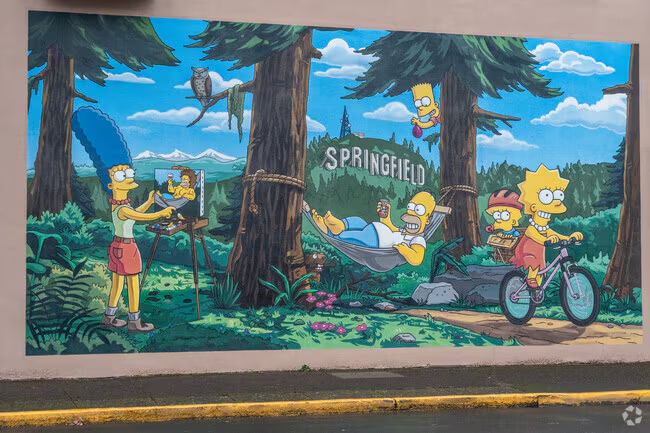
If walkability is high on your list, this is where to look first. Downtown Springfield has come into its own in the last decade, Plank Town Brewing, Washburne Café, Mezza Luna, the Wildish Theater, multiple coffee spots, and the Simpsons mural that finally settled the "which Springfield" debate. The Washburne Historic District just north of downtown is full of well-preserved Victorian-era and early 1900s homes with real architectural character. Pricing here ranges widely depending on condition, anywhere from the upper $300s for something needing work to $600,000-plus for restored homes with original detail intact.
Best fit for: buyers who want walkable urban living, character homes, and a true downtown feel.
Kelly Butte and Glenwood (West)
Kelly Butte sits west of Pioneer Parkway with hillside views and quick access to Island Park and the Willamette River. It's quieter than downtown but still close to everything. Glenwood, between Eugene and Springfield, is a mix of older homes, mobile homes, and properties that benefit from being right on the river corridor, and it's seeing real redevelopment interest as Springfield expands.
Best fit for: buyers who want river proximity and a foot in both cities.
Hayden Bridge (North)
Hayden Bridge is one of our favorite recommendations for first-time buyers and young families. The neighborhood sits along the McKenzie River with a mix of established homes and newer construction. You're close enough to downtown for convenience, but the streets are quieter and the river access is genuinely something.
Best fit for: first-time buyers, families who want river access, and anyone who wants newer construction without driving to the edge of town.
Gateway (North/Northwest)
Gateway is built around the Shoppes at Gateway mall and the I-5 interchange, which makes it the easy choice for commuters who need quick freeway access or anyone who wants to be near big-box shopping, and restaurants. Housing here skews toward apartments, townhomes, and more affordable single-family homes.
Best fit for: commuters, investors looking at rentals, and buyers prioritizing convenience over quiet.
Midtown (between Mohawk Boulevard and 42nd Street, south of Highway 126)
Midtown is where you'll find some of Springfield's most attainable single-family homes, particularly between Mohawk and 28th Street, where it's still possible to find houses under $300,000 in some price cycles. The trade-off is a more commercial, mixed-use feel and less walkability than downtown. South of Jasper Road, you're within walking distance of Clearwater Park and the Willamette River paths.
Best fit for: budget-conscious buyers, first-time buyers, and people who don't mind a more utilitarian neighborhood feel for the price savings.
Thurston (East)
Thurston anchors the east end of Springfield and is consistently one of the most popular family neighborhoods in the city. The draw is a combination of Thurston High School (strong athletics and CTE programs), the Thurston Hills Natural Area for hiking and mountain biking, easy access toward the McKenzie River corridor and Central Oregon, and a higher concentration of newer construction than you'll find in Springfield's older core. The hillside homes south of Highway 126 and east of Bob Straub Parkway tend to run higher, often in the $600,000-plus range, while the rest of Thurston offers a wider mix.
Best fit for: families prioritizing schools, buyers who want newer construction, and anyone who values quick access to outdoor recreation.
Jasper and Mohawk (rural fringe)
If you want acreage, a longer driveway, and quiet, look at Jasper to the southeast or Mohawk to the northeast. Both are rural in feel, larger lots, farmland, room for animals or a shop, while still being a reasonable drive into Springfield proper. Buyers should know that some properties out here have well and septic instead of city utilities, and lenders treat rural acreage differently than in-town homes, so it's worth talking through financing early if this is your direction.
Best fit for: buyers who want privacy and space, hobby farmers, and people willing to trade commute time for acreage.
A few things worth knowing before you buy in Springfield
A few things we tell every buyer who's new to the area:
Flood and wildfire risk are real considerations. A meaningful share of Springfield properties sit in or near flood-risk zones along the Willamette and McKenzie corridors, and wildfire risk is a regional reality across western Oregon. This shouldn't scare anyone off, it just means insurance shopping matters more here than in a lot of markets, and we recommend getting quotes early in the process rather than at the closing table.
Springfield Utility Board (SUB) is locally owned and handles electric and water for most of the city. Rates are generally competitive, and SUB has been expanding fiber internet service in parts of town, worth checking address by address.
School district matters even if you don't have kids. Springfield Public Schools (District 19) covers the city, and certain elementary attendance areas, particularly in Thurston, show up consistently in resale demand. If you're planning to live somewhere for under ten years, school zone is part of your eventual exit strategy whether you have kids or not.
Property taxes in Lane County are predictable but not the cheapest in Oregon. Budget accordingly and don't rely on the previous owner's tax bill if there's been significant reassessment.
The bottom line
Springfield isn't one market, it's a handful of distinct ones stitched together by Highway 126 and the river. The right neighborhood for you depends on what you actually do day to day: where you work, whether you want to walk to coffee, how often you'd actually use river access, and how much yard you want to mow.
If you're thinking about Springfield and want a real conversation about what your budget gets you in each part of town, we'd love to help. Our team lives and works here, and we'd rather have an honest conversation up front than waste your weekends touring houses that were never going to fit.
Reach out anytime, we're at 150 7th St in Springfield, or you can find the whole team at freedomrealtynw.com!